Tuesday, October 9, 2012

THE TOWER OF LONDON


The history of the Tower of London is high drama on an operatic scale replete with executions, treason, treachery and murder. There have even been apparitions of mournful ladies floating about holding their royal severed heads....

I'd planned to see the Tower on Saturday and had been warned that it was going to be mobbed with tourists. Agnes (our tour guide) had already shown me where to catch the bus so I set out early to beat the crowds loaded down with maps, water, snacks and expectations. London was also in the midst of an unseasonable heatwave, but I still looked forward to spending the day at this iconic symbol of England's power.

My guidebook told me that the Tower of London is not just a tower but a massive castle and it wasn't kidding. As soon as I saw it, I literally stopped and stared at the enormous brute force of it. It covers several acres with formidable walls punctuated every few feet by impenetrable looking towers.  Surrounding it is a river sized grassy area that had once been the moat.The very size of the Tower is enough to dissuade any potential invader, which is probably what William the Conqueror had in mind when he had it built in 1066. Situated on the north bank of the Thames, the Tower is strategically placed and it's easy to see that whoever possessed this immense fortress in medieval times would possess England.

The Tower of London
The former moat is now a pleasant lawn displaying weapons of siege.

I arrived just in time to join a gathering crowd for a guided tour by one of the famous Yeoman Warders or Beefeaters as they are also known.

 "Good morning Ladies and Gentlemen. Welcome to her Majesty's Royal Palace and Fortress the Tower of London. My name is Yeoman Warder Bates and for the next hour or so I'm going to be your guide around the fortress. I'm going to point out some famous buildings and structures and you're going to look at them and I'll talk about their history. Got that?

"I see, Madam, that you are looking at my uniform. It was given me by King Henry VII.  Well, not him personally but it is essentially the same as when he formed the Yeoman Warders to guard the Tower in 1485. These blue and red uniforms are our "undress" uniforms.  The fancy red and gold ones are only worn on state occasions, and yes, they are uncomfortable. And, we are called Beefeaters because we are fed very well. We must be strong to guard the Tower, you see.

"Now, I'm sure you want to know how I got this cushy job. I had to be in the Queen's employ in the Armed Forces of the Commonwealth for at least 22 years. It is required to have a Good Conduct Medal and we must like people. Well, tolerate them anyway." I'm sure they also were chosen because they were outgoing, charismatic and very funny.

So off we went our stalwart Beefeater and his gaggle of tourists, to learn about the Tower of London.  As we walked, he explained that since its building the Tower has served as a royal palace, fortress, prison, royal mint, armory, treasury and home to the Crown Jewels. We stopped at Traitor's Gate, a water entrance from the Thames where prisoners (Anne Boleyn for one, Yeoman Warder Bates assured us) were brought by boat into the castle. The walls of the Tower had once fronted the Thames which had also supplied the water for the moat.


Traitor's Gate through which prisoners were brought by boat from the Thames.

From there we walked to the center of the fortress to the White Tower, a magnificent building literally "towering" over all the rest. Named for its original white washed exterior it was built in 1078 by William the Conqueror as a royal residence and stronghold and gives the entire castle its name. It now houses an impressive display of suits of armor one of which is Henry VIII's with its equally impressive cod piece (a protective covering for the family jewels). Upstairs are exhibits of armory of all sorts, plus a fine example of the latest in medieval toilets called garderobes. Built into the walls they consist of a bench covering an opening that emptied right into the moat. When the tides failed to flush the moat out, I'm sure you wouldn't want to be downwind of it.

 Henry VIII's huge armor and vanity displayed.

 The largest and smallest armor on display.

 One of the garderobes or toilets that emptied into the moat below.

 St. John's Chapel built with lovely buff colored limestone.

Window in St. John's Chapel

Our Yeoman then guided us to Tower Green (a spot of lawn beside the White Tower) and to a memorial where our guide tells us, only "friends of the King" were executed. Actually only seven people, mostly women, were executed there because their deaths were too politically charged for public viewing. Among those whose heads rolled on these grounds were Anne Boleyn and Catherine Howard, second and fifth wives to Henry VIII. The only male who lost his head upon the Green was the Earl of Essex, Queen Elizabeth's "favorite" who betrayed her. Anne Boleyn is buried just a few feet from her beheading in the Chapel Royal of St. Peter ad Vincula. She and the others executed there were gruesomely buried in the Chapel without their heads. It was eerie and sad standing on the same spot where these people lost their lives in such a horrific way knowing they had been utterly abandoned.

 The Tower Green, and former Queen's Palace, now housing the Yeoman Warders and families.


 Chapel Royal of St. Peter ad Vincula where Anne Boleyn and the Earl of Essex
are buried.  It is right across from the execution site.

The most infamous murders within the Tower walls were of the two little Princes in what is now known as the Bloody Tower in 1483.  Two boys, 12 year old Edward and 9 year old Richard were the sons of Edward IV and heirs to the throne. Shortly after their father died, their uncle, Richard Duke of Gloucester declared them illegitimate and confined them to the Tower. Richard then became the heir and was proclaimed King Richard III. Soon after that, the boys conveniently disappeared. Bones thought to belong to the boys were discovered in 1674 when a building within the Tower was demolished. Richard died in battle a year after becoming King. Was this a fitting end to a brutal man or was he wrongly accused of their murders? It is still a mystery.

Our tour being over, I was on my own to explore and headed straight for the Jewel House where the Crown Jewels are kept. It was beginning to get really hot and I appreciated the cool dark rooms where the jewels were displayed. I marveled at these priceless symbols of the Monarchy, crowns and scepters encrusted with priceless gems of astonishing size. The Imperial State Crown holds one of the largest diamonds ever found and the Royal Scepter has one the size of a golf ball.

 The medieval Royal Apartments situated above Traitor's Gate.

 The Royal Apartment's Tudor style walls.

 The King's Chamber

The King's Chapel

After a delicious focaccia bread sandwich at the Tower Restaurant, I climbed one of the staircases to the top of the defensive wall where it was a little cooler in the shade of the sheltering trees. It's possible to walk the entire circumference of the castle passing through the guard towers, but I just went a short way pausing often to enjoy the great view of the Tower Bridge. Also from this vantage point I could see the Raven's Keep where, our Yeoman explained, at least 6 ravens are cared for at all times. Legend has it Charles II believed that if the ravens ever left the Tower, the fortress and the kingdom would fall, so there is actually a Ravenmaster who feeds them raw meat to ensure their loyalty. By then it was around 3pm, and I was hot and tired and ready to go back to my hotel. It was a wonderful day and one more item was checked off my bucket list.

 View of the White Tower on the left, Raven's Keep on the right, the
surrounding castle walls and Tower Bridge with the Olympic Rings still displayed.

 View from the castle walls.

 On the wall going from tower to tower.

 View from one of the towers.

 Raven's Keep where the ravens are cared for.

 A raven in front of one of the Yeoman Warder's homes.

 Tower Bridge as seen from the Tower of London. The Summer Olympics had just finished.

Double click on any picture for full screen image.
Next time: Stonehenge and Bath

Monday, October 1, 2012

WESTMINSTER ABBEY, THE CROWNING PLACE OF KINGS

Westminster Abbey does what it was intended to do: inspire awe and reverence. 
Ancient, it is filled with the ghosts of greatness, yet it is also history in the making. 

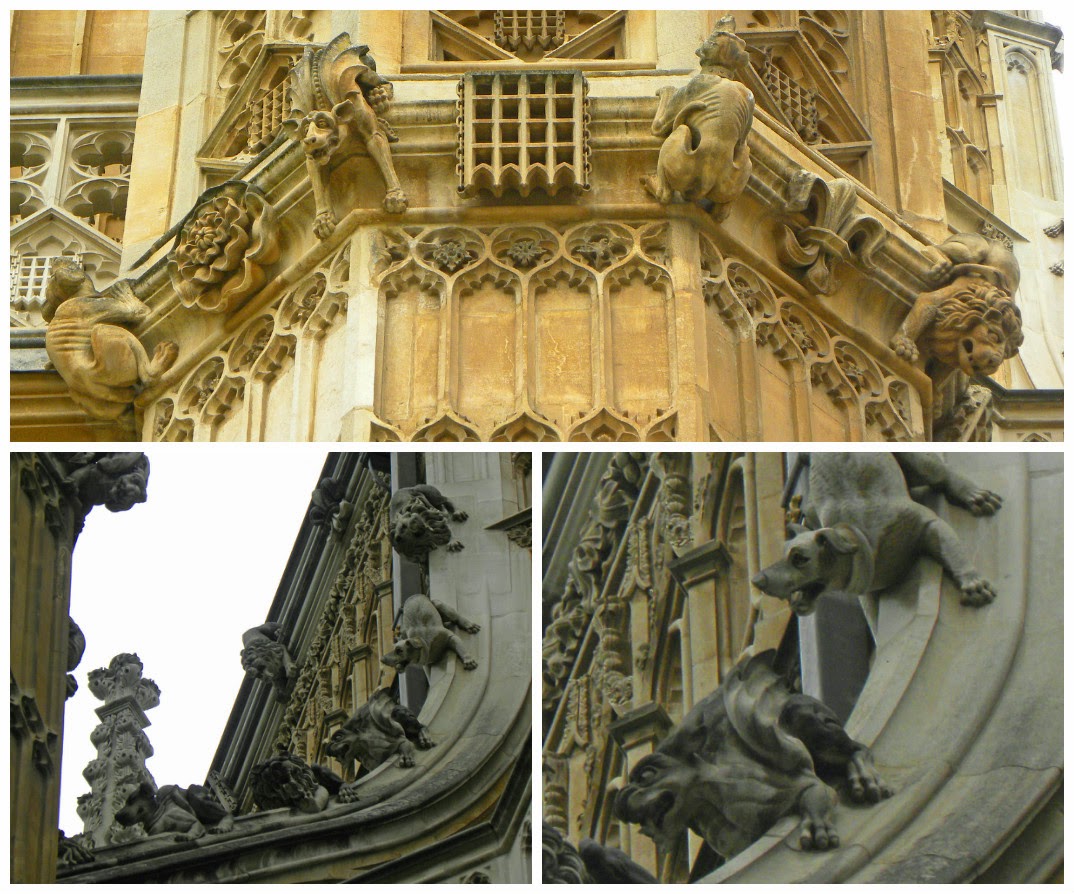
When I first saw the Abbey, I was struck by how old it was. It looked every bit its 1,000 years on earth with its sharply pointed Gothic arches and sturdy flying buttresses festooned with grimacing gargoyles to scare off evil spirits.Then as I walked around the Abbey I saw it had been built in stages, making it look almost like two different churches. William the Conqueror, having built it, was one of the first to use the north entrance pictured below for his coronation on Christmas Day in 1066. The newer west entrance was added in 1745 and was used by Queen Elizabeth II when crowned Queen of England, and recently by Kate and William when they married.

On the left is the original Abbey, completed in 1065.  The newer addition, added
in 1745, is on the right.

Gargoyles galore
 Abbey grounds. The Abbey was first established by Benedictine monks in 960.
  Upper left is part of the original ceiling in the cloisters.

The Crowning Chair

Why the Abbey is such a treasure, however, didn't hit me until I went inside and saw the thousands of tombs and monuments. Amazed, I read name after name chiseled in marble of some of the most famous people in history. Among the 3,000 buried there, the most notable are Queen Elizabeth I and Mary Queen of Scots (ironically buried across from each other), plus no less than 16 kings. Then there are the giants of science and literature: Chaucer, Charles Dickens, Darwin and Sir Isaac Newton, just to name a few. Knowing that I was walking on the graves of people who shaped our history was astonishing enough, but remembering the world changing events that took place here over the last millennium (royal marriages, burials and coronations, for example) made me realize that Westminster Abbey has to be one of the most important places in western civilization.

Even with all that, it was the Coronation Chair I couldn't wait to see. But, my excitement quickly turned into disappointment when I saw that it was completely inaccessible. It is set so far back behind a thick pane of bullet proof glass that it seems insignificant and small. Frustrated, I almost walked away when I noticed the large rectangular shelf under the seat. Wondering what it was for, I fortunately took the time to read the sign explaining that King Edward I had ordered the making of the Coronation Chair in 1296 to specifically hold the prehistoric crowning stone of kings known as the Stone of Destiny. But, the stone was missing...!

I was beyond excited because not only did I know where it was, I'd seen it. The last time I toured Scotland I saw the Stone of Destiny at Edinburgh Castle and had been very impressed by its importance to Scottish identity and heritage. I'd even visited Scone Palace where it had been in a place of honor for centuries. Every Scottish king, Macbeth included, had been crowned while sitting on it. The Stone held such symbolic importance that Edward I took it in 1308 (or as the Scots tell it, stole it) to prevent Scotland from having its own kings in the future. It remained in England until the Stone was snatched by two daring Scottish college students in 1950 prompting negotiations to return it permanently to Scotland. Finally returned with great ceremony in 1996, it will now only be borrowed to fill the shelf under Edward's chair for future coronations.
The Crowning Chair used for every coronation since 1308, built to hold
 the Stone of Destiny. (Picture courtesy of Abbey souvenir brochure.)

 Replica of the Stone of Destiny, or Stone of Scone--(sounds like spoon) is at 
Scone Palace, Scotland.The original is on display in Edinburgh Castle. 
Macbeth was crowned right here!

Buckingham Palace

I became friendly with a couple on the tour from Texas, Dan and Judy, and after we visited Hampton Court Palace we decided to go exploring together. First we toured Westminster Abbey then, acting as tour guide, I suggested we walk up to Trafalgar Square stopping, of course, at the Silver Cross for more steak and ale pie. After dinner, I persuaded them to walk with me to Buckingham Palace, which I was sure, not more than a few blocks away. We even got directions from a helpful Brit, but what we didn't know was that the road to it was blocked off and we had to detour around several blocks.

When we finally arrived it was dark, but well worth it.  There was hardly anyone around and it seemed as if we had the place all to ourselves. The Palace is not only gorgeous but beautifully lit, glittering in the moonlight like the Crown Jewels. It's open in August for tours, but I didn't realize it required making reservations well in advance. By the time I realized that it was too late to get tickets. But seeing the Palace at night with hardly anyone around was a pretty good consolation prize.  (Word to the wise:  buy tickets in advance!)

Buckingham Palace in daylight, just in time for the changing of the guards!


SUGGESTED READING: "The White Queen" by Philippa Gregory (An historical novel about Edward IV, his Queen and their boy Princes who were imprisoned in the Tower of London. The Queen took sanctuary in St. Margaret's Church next to the Abbey)

Next time:  The Tower of London
(Click on any picture for a full screen slide show)

Monday, September 24, 2012

HAMPTON COURT PALACE


 Hampton Court Palace

London,  Day 2

Imagine it's the summer of 1528 and you are Henry VIII. London is hot, the air stifling, and the Royal Palace at Westminster is downwind of a very foul smelling Tower of London. You say to heck with this and collect your wife of the moment and 800 of your closest courtiers and sail upriver 10 miles in the Royal Barge to your favorite Palace, Hampton Court. Surrounded by acres of lush green countryside, it has an abundance of game, and swans swim leisurely in languid ponds; it is pure heaven. However, there is only one hitch. The Palace doesn't belong to you.

There is nothing worse than being King of England and one of your lackeys has nicer digs than you.  Cardinal Wolsey, Archbishop of York, made the fatal mistake of out styling the King. Not only that, he was unable to persuade the Pope to grant Henry's divorce from Katherine of Aragon and that sealed the deal.  Henry confiscated the Palace as his own, and for the next ten years transformed Hampton Court into the most modern, sophisticated and magnificent palace in all of England and Europe. He added tennis courts, bowling alleys, pleasure gardens and a maze, 1,100 acres of hunting grounds, a vast dining room (the Great Hall) and a huge 28 person capacity bathroom euphemistically called the "Great House of Easement". It remained Henry's favorite until his death in 1547.  All six of his wives visited the Palace and he even married his last wife there, Catherine Parr in her sumptuous private chambers.

Years after Henry VIII's death, the Palace remained an important place in which to entertain and impress. King James I loved plays and William Shakespeare and his "King's Men" were often booked to produce his plays for royal audiences.

In 1689, the Royal reigning couple William and Mary transformed the Palace into a baroque beauty, replacing chimneys, adding towers and changing the east and south facades, giving it a strange mixture of medieval sturdiness and graceful elegance. Many of the gardens were dug up and replaced with sculpted landscapes popular on European grand estates.  

The gardens were my favorite part of the Palace.  I spent most of the time we had allotted outside greedily taking as many pictures of as many of the gardens as I could.  Nature and man’s careful grooming of it are what appeals to me most. I'm sure Henry would agree with me that a home is not complete without a landscape full of flowers.
 
The medieval or Tudor front entrance.


The English love their clocks.  This one is a very unique 24 hour clock.

Part of the original medieval building, beside the kitchens.

The kitchens were immense, capable of feeding hundreds per day.


The Great Hall.  Henry the VIII ate here!

William and Mary's elegant baroque facade.

William and Mary added the ornate chimneys, some of which are only
ornamental.  Wealth was exhibited sometimes by the chimney count.

One of the many gardens.


A board game the courtiers may have played outside the King's chamber.
 
Next time:  Westminster, Buckingham Palace and Dan the Veterinarian

Click on any picture for a full screen slide show.

Monday, September 17, 2012

LONDON, 2,000 YEARS OF HISTORY IN FOUR DAYS


London, Day One

I booked a pre-trip that gave me about three and a half extra days in London in which to see all the hot spots, minus time out for an included tour of Hampton Court Palace and a guided bus tour of the city. I knew I was going to have to run around like a maniac to see a tiny fraction of all there is to see in London. But, I was prepared; I'd made a list and a time table and I was determined to do my best.  My list included, The British Museum, Trafalgar Square, Buckingham Palace, Westminster Abbey, Parliament and Big Ben, the Tower of London and the Tower Bridge.

The flight over was perfect.  I took a direct night flight from San Diego arriving in the afternoon, England time, ready to hit the streets of London. Part of the tour package included being   "chauffeured" to our hotel, the Park Plaza Country Hall. Once there I was greeted by our hospitality guide, who reminded me of a merry garden gnome wearing sensible English shoes.

"Hello! My name is Agnes." Actually, it was Alex but I heard Agnes, so Agnes she became. "You are the last to arrive. I've already taken the others on a walk about, so do come with me and I'll point out some things of interest on the way to catch my bus. Shall we?" And with that I was hustled out the door.

Agnes may have been diminutive but I had trouble keeping up with her as she smartly cut through the throng of people on Westminster Bridge with surprising speed. She was obviously very accustomed to navigating London crowds.Trying to keep up with her I struggled to stay close enough to hear her abbreviated orientation speech.

"On your right is the London Eye.On your left ahead is Parliament and Big Ben. Westminster Abbey is just beyond that. After we cross the bridge you'll see Whitehall on your right. Walking up Whitehall will be Trafalgar Square. Welcome to London! Cheers!"

After waving goodbye to Agnes at the bus stop, I strolled around Parliament and the Abbey for quite awhile mesmerized by their beauty and the enormity of their historic significance taking picture after picture. I then walked north on Whitehall passing the Prime Minister's home on #10 Downing Street and the Royal Horse Guards Parade Grounds (site of the 2012 Olympic beach volleyball games). By the time I wandered all the way to Trafalgar Square the sun was setting and my stomach was grumbling. A sign advertising steak pie made me turn a sharp right into the Silver Cross pub. A quintessential English dinner sounded like the perfect meal for my first day in London. Wrapped in a biscuit crust the steak pie tasted sort of like pureed pot roast and was yummy. Meanwhile, struggling to finish it to the last bite I decided that my first day in London by myself had gone very well.

(Double click on any picture for a full screen slide show.)


View (from left to right) is the London Eye, Westminster Bridge, Big Ben and Parliament. 
 My hotel was located two blocks left of the Eye.  The picture was taken from the Hungerford Bridge.

My camera's wide angle lens distorted old Ben, but it's still a great shot!
(Big Ben is actually the name of the bell, not the tower or clock, but it will always
be Big Ben to us.)


This is the "Sovereign's Gate" where the Queen enters to address Parliament.

Westminster Abby

#10 Downing Street is the famous residence of the Prime Minister.  It is gated
and under armed guard.

View down Whitehall.


Horse Guard Parade Grounds.  Once used as jousting grounds for the knights.


Beware of Royal biting horses!


The Admiralty Arch, gateway to Buckingham Palace
and St. James Palace, home of Prince Charles.


Trafalgar Square and Admiral Nelson's column.  King Charles I is in the front.


I love the Union Jack hat!


 An architectural jewel off Whitehall.


Silver Cross pub on Whitehall close to Trafalgar Square.

 They serve an outstanding steak and ale pie, which I had three
times while I was in London!  English comfort food.  Yum!
SUGGESTED READING: "London" by Edward Rutherfurd (Excellent historical novel chronicling the history of London and Britain.)

Next time: Hampton Court Palace 


Monday, September 10, 2012

MY GRAND GALLUP THROUGH GREAT BRITAIN

Map of my Grand Gallup through Great Britain

I realize I've gone a bit overboard with the alliteration, but it aptly describes the wild romp I just had through parts of England, Scotland and Wales. Grand Circle Tours expertly guided a group of us through 2,500 miles of spectacular scenery and centuries of British history in just two weeks. If I hadn't written a daily journal, I'd never remember where I'd been or what I'd seen. But, even though we breezed through some places way too fast (like the Cotswolds), I'm very happy with the variety of historic places we saw, the unique experiences arranged for us, and especially the people I met.

This was my first trip abroad by myself. Up to this time, I'd put off traveling alone for two big reasons: #1, it's so much more fun to travel with people I know, and #2, I like being in control of the pace and agenda. I'm admittedly spoiled by the luxury of seeing what I want to see for as long as I want to see it. This time I couldn't tempt anyone to come with me, so if I was ever going to see England, I had to screw up the courage and go by myself, which meant a tour. Now, tours have their good points and not so good points. The downside is they set the pace and determine what the group sees. Ironically, it is also one of their strong points. On my own, I would never have seen or experienced as much as I did.

Frankly, I did not look forward to traveling with a group of strangers. I knew from experience that who one goes with could make the trip a joy or a misery. But, the 22 well traveled and gregarious people on this tour pleasantly surprised me by being just plain fun to be with. A great deal of the credit goes to Anita, our tour guide, who with unfailing good humor herded us through Britain like a good sheep dog. She entertained us with her anecdotes about growing up in Liverpool while passing out samples of the foods England, Scotland and Wales are known for--everything from cheeses to blood pudding. And, it never failed to delight us when pointing out items of interest along the way she often mixed up her right and left directions. We got rather used to it; when told to look to the right, all heads dutifully swiveled left.

Then Sean came into our lives. I fell in love with him the first time I saw him in a gift shop in Portmeirion, Wales. I couldn't resist his goofy little face, Celtic green eyes, and his bean filled belly.  He quickly became the rock star of the tour group, everyone becoming a member of his fan club.  "How is Sean today? Did he sleep well?" they would ask. And Larry and Steve, brothers and partners in crime, frequently snatched him and left ransom notes. So it was Sean the Sheep, without saying a word, who transformed 22 polite strangers into a group of friends sharing a wonderful experience.
       Sean and I at Hadrian's Wall


Top left to right, Sean and Anita (our guide), Paula at Whitby Abbey,
Chuck at Hadrian's Wall, John at Whitby Abbey, Darlene at our farewell party,
and finally--Steve and Larry,the sheep snatchers, at Hadrian's Wall.

Sean charmed hearts all over Great Britain--from the town cryer in Chester, 
to the salesgirl in a sweetie shop. He was coveted by Vikings in York, 
snatched by brigands in Stonehenge,
and protected by a Highlander guard in Gretna Green!


So thank you Anita, Davy (our driver who drove us safely over those 2,500 miles), Barb and Larry, Paula and Chuck, Ruthie and Steve, Pat and Bill, Darlene and Harley, Rosalie and Joseph, Cathy and Jim, Gervaise, John, Frank, Judith, Susan, Barbara, and Brenda for making this trip a joy. And to Judy and Dan who had to leave us too early because of a family loss, you were both missed.  Oh, and thank YOU Sean the Sheep.

      Who could resist those adorable googly eyes??

 
Larry caught red handed snatching Sean.

Next time:  London!