Thursday, June 22, 2023

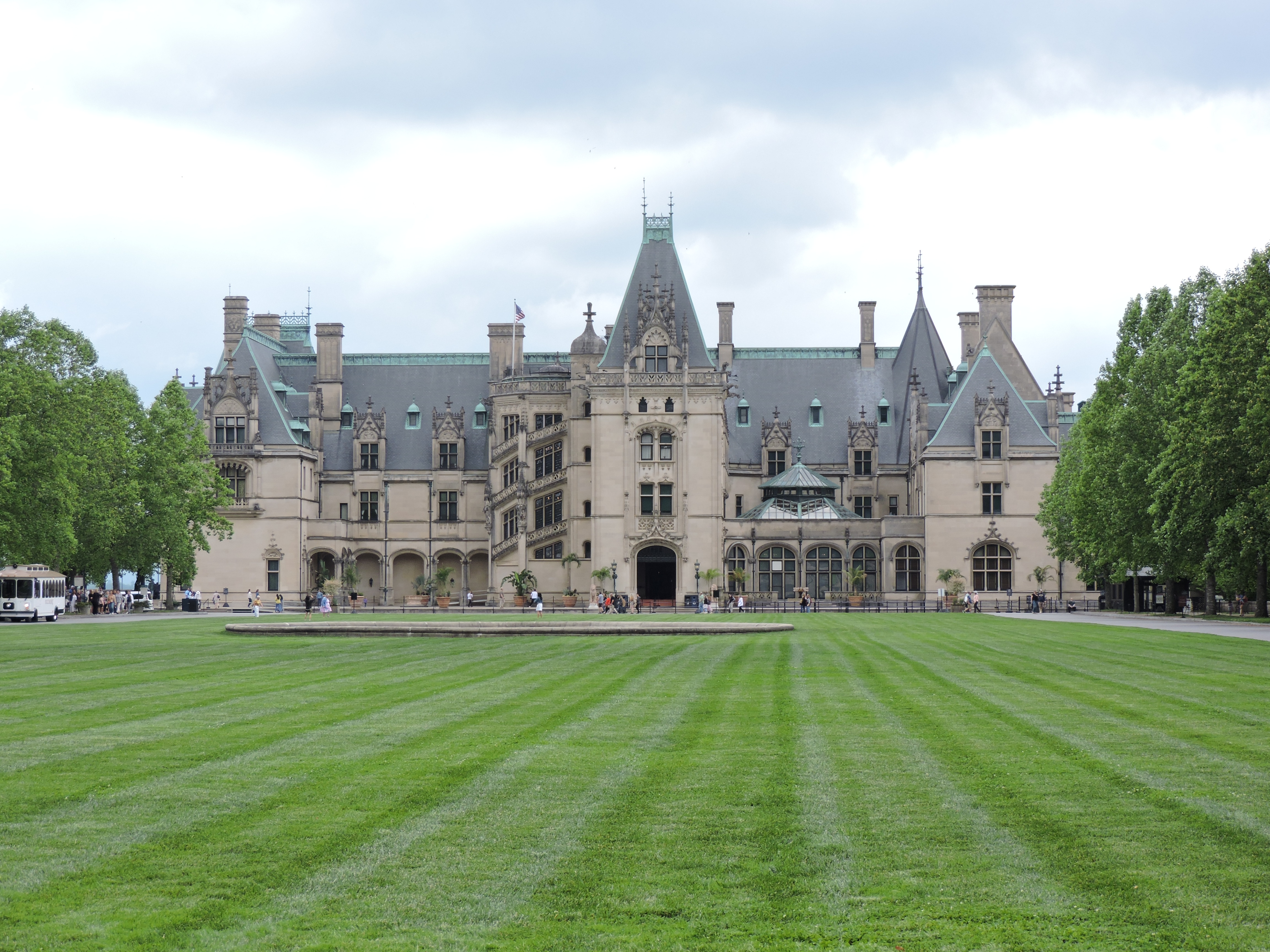
THE BILTMORE, AMERICA’S DOWNTON ABBEY


So, you’ve done the “Palace and Castle” tours of France, England and Italy and you can’t imagine anything more spectacular than those. Well, Friends, prepare to have your socks knocked off!

The Biltmore has always been one of the top places on my list of things I really, really have always wanted to see, and thanks to my BFF’s and travel buddies, Kay and Tom, my wish was fulfilled a few weeks ago. After several years of planning a road trip through the Smoky Mountains, we finally set a date and made our reservations. Flying into the Raleigh Airport in North Carolina, we joined up with our friend, Gayle, rented a car and headed for Asheville and my dream destination, the Biltmore!

ASHEVILLE, NO. CAROLINA

Asheville is gorgeous. One of the top producers of American made furniture, it is easy to see why. The quaint town is in the midst of hundreds of miles of lush, green forests so thick it’s a wonder the first pioneers ever found their way through them. George Vanderbilt so loved this area that he decided to build a home here to take in the spectacular views. The result is one of the most beautiful homes I’ve ever seen and I’ve seen some of the best.

There is so many positive things to say about the Biltmore that I could gush on and on for hours, however I will spare you that agony and encourage you to read the links I have provided at the end of this blog to give you more detailed information. I will say this: I could live there for the rest of my life and the next one. Happily. It would like being on a perpetual episode of Downton Abbey complete with all the upstairs, downstairs drama. I could easily imagine what it must have been like at the turn of the 20th century, filled with laughing and lighthearted guests and family coming and going after playing golf or riding the trails on horse back or just taking a stroll through 75 acres of exotic gardens…because this 250-room home was built by George Vanderbilt expressly for the pleasure of his family and guests.

The thrills begin at the main gatehouse just outside downtown Asheville. George Vanderbilt hired one of the best landscape architects in America, Frederick Olmsted, (who designed Central Park in New York) to transform hundreds of acres of worn-out farm land into a paradise of natural beauty. Olmsted designed a three-mile entry road that would leisurely take Vanderbilt’s guests up to the home. On the way the guests could admire the beauty of the carefully cultivated landscape thick with flowering rhododendron, azaleas, evergreens and countless natural plants. It was designed to hide the house from view by the vegetation until at the very end of the road where it is suddenly revealed…and the effect is stunning! Built in the style of a French chateau, it rises out of the landscape like the jewel it is. It literally took my breath away.


Our tour of the house was wonderfully managed. Only a few guests are allowed in at one time and I thankfully never felt rushed or overwhelmed by a crowd of visitors. We were given plenty of time to see everything and best of all, take a ton of pictures! (*Be sure to book your tickets well in advance!)

As we passed through the huge ornate doors of the main entrance, we were welcomed into a spacious light-filled entry hall, but our attention was immediately drawn to the Winter Garden on our right. If I lived here, I would never leave this space. Chocked full of tropical and flowering plants (all grown in the Estate’s gardens and greenhouses), it is softly lit by an immense skylight. Scattered around the tiled floor are comfortable seating areas, perfect for curling up with a good book.

The home is decorated with the finest antiques and furnishings which Vanderbilt spent months shopping for all over the world. Yet for all of its luxury, it feels like a comfortable home. First of all, it is built with large windows everywhere in order to take in the spectacular views of the Blue Ridge Mountains in the distance and the carefully planned panoramas of the surrounding landscape. The rooms are spacious, each opening up to the other giving one the feel of a wonderful, light-filled space.


To the right of the Winter Garden is the jaw-dropping main dining room. Designed to be able to seat dozens of people or serve an intimate dinner in front of the fire, it is impressive for its size and appointments. At one end is a pipe organ whose workings take up an entire room in the basement.


Antique mantle and print in the music room.


Smaller dinning room with portraits by Singer Sargent.


A sitting area next to the Winter Garden and opening onto the loggia.

Spectacular view looking west toward the Blue Ridge Mountains from the loggia. The home is built to be able to take in the magnificent views from any room in the house.


The long room is designed to enjoy the west facing views and is a wonderful spot to take tea, read a book or just sit and talk. The antique tapestries that line the walls are vibrant and stunning. Every room is equipped with one or more fireplaces even though the house has central heating. It was built with all of the modern conveniences of the time, including telephones and electricity. Each bedroom had its own bathroom.


The library was George Vanderbilt's favorite place and is filled with thousands of hand picked volumes. There is a hidden entry to the library behind the fireplace so that it could be accessed from the second story bedrooms. The painted ceiling is reminiscent of Versailles.


The spiral staircase as seen from inside and outside of the home is an architectural gem.

George Vanderbilt thought of everything his guests could do no matter the weather. There is a heated indoor pool, a state-of-the-art exercise room, a billiards room, a two lane bowling alley, lawns for golfing, croquet, lakes, ponds and a river for fishing and boating, trails for horse back riding, and acres of gardens for just leisurely strolling. Of course, I loved the gardens...


My BFF, Kay. Celebrating our 60th Friendship Anniversary!
Looking good, Sister!


The greenhouse. All of the flowers and foliage used throughout the house are grown on the property.

Before we left, we had lunch in the converted stable next to the house. Even the horses lived in luxury! I had a pina colada milk shake from their dairy bar that was the best thing I ate on the trip! All of the dairy products are from the estates own dairies. The estate was always designed to be a self-sustaining enterprise. 


**You can click on any picture for a full sized slide show.

The attached links will tell you much, much more about this amazing house and its history. Enjoy!


Tuesday, February 1, 2022

A WEE TOUR OF SCOTLAND (PART 4), STIRLING CASTLE


    Sitting atop a massive volcanic outcropping, Stirling Castle dominates the landscape.

If you want a swashbuckling tale of bravery and betrayal, murder and intrigue, the story of Stirling Castle has it all. From William Wallace, Braveheart himself, to Mary Queen of Scots, more famous names are associated with this towering edifice than another place you can name. Kings and queens made their beds there giving birth to more kings and queens. As the gateway to the highlands of Scotland, it saw many a bloody battle fought over it year after bloody year. The Romans learned to leave it alone, but the British were more persistent. The Scots lost it to the British only to gain it back and lose it again and again until James VI became the first Scottish King of England and settled the matter. 

The story of Stirling is the story of Scotland

In the beginning, as all good tales are told, the land to the far north of England was a wild and rugged place. Not even the mighty Romans, who sought to rule the island, could conquer the ferocious people who lived there. Like demons they were, with their painted faces and long streaming hair they fought like wild cats and knew no fear. The Romans named the painted ones, Picts, while, the others they called, Scoti, Latin for the Gaels. Interesting enough, the original “Scoti” migrated from Ireland, settling on the western part of what is now Scotland while tribes of “Picts” inhabited the eastern part. Over the centuries, they eventually merged into the unique Scottish people we know today.

Stirling Castle sits atop a massive volcanic outcropping that has been a Scottish stronghold since ancient times. Strategically placed, it guarded what was, until the 1890’s, the farthest downstream crossing of the River Forth. To get to the highlands, and to avoid going upriver where the Forth widened into a marshy and treacherous crossing, invaders needed to cross Stirling Bridge. This narrow wooden bridge made William Wallace, Braveheart, famous.

In 1297, during the First War of Scottish Independence, a British force of thousands led by John de Warenne, The Earl of Surrey, stormed the bridge only to be defeated by Scottish fighters led by Braveheart. The British lost over 5,000 men to Wallace’s few. An incredible triumph, it is celebrated by the Scottish to this day. A towering monument to Wallace sits a few miles away from the castle as a reminder that Scotland’s heart will always be free.


King Robert the Bruce takes pride of place on the castle grounds, but it is the monument to William Wallace that commands attention.

Monument to Braveheart, William Wallace

A private tour of the castle

It had been another nonstop day of rain when my friends, Kay, Tom and I arrived late in the afternoon to tour Stirling Castle. Most of the tourists had already left so we practically had the place to ourselves. We discovered this strategy by accident, but now I highly recommend it! Come late—no crowds!


The entrance meant to be foreboding, leads us into a medieval courtyard. Nothing fancy here, it none the less has plush interiors to soften the utilitarian exteriors. 

The Great Hall


 The Great Hall, the largest in all of Scotland was built to entertain in lavish style.

 
The huge hall could hold hundreds of guests and has 5 immense fireplaces. Imagine all the gorging and butt grabbing that took place. Ah, good times!


Queens in our own minds, Kay and I command the royal dais!


The Palace, built for James V and his French Queen, Mary of Guise, was also occupied later by their daughter, Mary, Queen of Scots.


The Palace was closed for remodeling when we visited, however we were given a taste of what it would look like hung with these magnificent tapestries. These exact replicas of the original wall hangings were made in a special studio on the castle grounds. To see the finished Palace in all of it's splendor, click on the link: https://www.stirlingcastle.scot/discover/gallery/


The weather cleared long enough to take this picture from the Castle toward the town of Sterling.


Practically alone in the castle, we sensed echoes of the past around every corner.

For more information on Stirling Castle, click on the link:  https://www.stirlingcastle.scot/

Sunday, October 24, 2021

A WEE TOUR OF SCOTLAND (Part 3), CRANNOGS, IRON AGE LUXURY LIVING


The Scottish Crannog Center at Loch Tay
Just across the lake (Loch Tay) from our timeshare in Kenmore, is a wonderful opportunity to walk back in time to see how prehistoric people lived in this lush and beautiful land called Scotland.

On our second day in Kenmore, we drove a short distance away to a museum site, The Scottish Crannog Center. Underwater archeology in the 1990’s found remnants of a classic crannog dwelling in the lake, and that discovery became the perfect opportunity to not only rebuild the structure, but to incorporate it into a larger vision. That vision of a living museum with docents dressed in the latest fashion of Iron Age apparel going about their daily Iron Age chores became one of the highlights of our trip.


Crannogs, Luxury Lake Living in the Iron Age

OK, I hear you ask, what is a crannog? First of all, the word comes from old Irish meaning a wooden structure or vessel and came to mean a lake dwelling. These multi-use dwellings were built several feet into the lake supported by hundreds of wooden pilings,  and connected to the shore by sturdy piers that could be barricaded off at night for protection.  They are found all over Scotland and Ireland, with Scotland having the oldest known crannogs dating from about 3,500 BC. Loch Tay alone has 18 of these.


Inside the crannog are all the comforts of home:
  a loom for weaving cloth with a handy supply of wool... 


...central heating and cooking facilities combined...


...and a luxurious sleeping loft with accommodations for the pigs and chickens etc. underneath.

An entire extended family, (mom, dad, kids, gramma, grampa, etc.) plus their animals would shelter in a crannog. Tucked in for the night with central heating, a private loft for mom and dad, and fresh goats milk on tap, what more could you want? Looks like the good life to me! Built next to rich farmland and easy access to trading networks on Loch Tay, they appear to have been inhabited by prosperous people who lived in peace for several generations.

Tom, an avid wood worker himself, is given a chance to see what tools an Iron Age carpenter would have used. Here he is working a lathe which produces quite sophisticated results. In fact, all of the tools that were used are ingenious allowing for quite a comfortable existence.

I was amazed by the complexity of the loom. If left up to me, I would still been wearing animal skins!

Demonstration of how bowls were carved out using Iron Age technology. 

During the day, the villagers lived and worked outside the crannogs.

For more information, click on the link:  Scottish Crannog Center

Stay tuned for more of Bonny Scotland!

Wednesday, September 22, 2021

A WEE TOUR OF SCOTLAND (PART 2) KENMORE AND LOCH TAY

Of all the places you could plop yourself to be totally immersed in the history, ambiance, and yes, romance of Scotland, you could do no better than Kenmore. Located 80 miles north of Edinburgh in the Scottish highlands, it’s neatly tucked in between misty mountains on one side and Loch (or lake) Tay on the other.


With Tom driving on the wrong side of the road, on the wrong side of the car, shifting with the wrong hand and Kay yelling, “Shift! Shift!” at every roundabout, we managed to safely leave Edinburgh and make our way to Kenmore. Kay had arranged for us to stay in a timeshare there, but none of us were prepared for how lovely it was. The white washed cottages surrounded by ancient looking stone walls covered in the red leaves of autumn was a photographers dream.


The walls of our timeshare in Kenmore.


With Loch Tay in the foreground, our timeshare is shown in its lovely setting.


This is the view of the courtyard from our balcony. On our first evening there, a lone bagpiper stood in the middle of it and played for us. It made the whole trip!


The ducks came every morning to be fed. We were more than happy to oblige.


Across the road from us is the town center of Kenmore, which has the boosting rights of having the oldest working inn in Scotland. 


Kenmore is also the gateway to Taymouth Castle, classically Scottish in all its entire brooding, fortified looking exterior. Or at least that’s how it seemed to me. When we saw it, it was fenced off, dark and rather gloomy. In the process of being renovated then it is now restored to the opulent dwelling it once was. One of the most famous castles in all of Great Britain, it was where Queen Victoria spent her honeymoon. It stands on the site of the much older Bullock Castle, which was built in 1552 as the seat of the Campbell Clan. Demolished in the 19th century by the Campbells, a much larger neo-Gothic castle was built in a rather imposing blue-grey stone. The exterior is lightened by soaring stain glass windows and the interiors are now bright and welcoming.  Lavishly decorated it is once again a resort fit for royalty.


Taymouth Castle then, fenced off, run down and rather spooky. With darkened windows and weeds as high as a man's thigh, chain-link fencing all around, it is too easy to imagine the ghostly vapor of headless Highlanders roaming the halls at night.


Taymouth Castle now, elegantly restored.
For more information: Taymouth Castle


The Taymouth Castle estate includes a championship golf course, formal gardens, and miles of walking trails. We frequently used this road on the property instead of the main one because the lush scenery was so breathtaking.

Saturday, August 28, 2021

A WEE TOUR OF SCOTLAND


A few years back, my close friends, Kay and Tom Law, and I toured Scotland on our own. It was my first trip to the UK and it ignited a passion for this historic island that only grows with time. The following is the tale of our romp through the heathered highlands, visiting the haunts of Robert the Bruce, MacBeth, Robbie Burns, and eating our fill of steak and ale pie!

First stop, Edinburgh

Kay, Tom and I boarded our Continental flight in San Francisco with ear to ear grins. We were so high with anticipation that it didn’t daunt us in the least to know that between the time change and our stopover in Newark, NJ our flight to London would take 24 grueling hours. The only worrisome thing was the weather. It was late in August and Hurricane Bill had come up the Eastern coast of the US and then hung a right headed straight toward Scotland. We’d packed for nonstop rain just in case, but hoped for the best.

This was the Law’s third trip to Scotland (my first) and they had invited me to join them in exploring new places and places that merited visiting again. I was more than happy to let Kay be our tour guide and Tom our driver through this land of our ancestors, the Stewarts, Sutherlands, and McClarens. We planned to spend three days in Edinburgh to see the sights, but the main event was to attend the Military Tattoo, an annual extravaganza that culminates a month of citywide festivities. Afterwards, we would rent a car and drive to the timeshare they had booked for us in Kenmore on Loch Tay, 80 miles NW of Edinburgh. Kenmore would be our base camp while we toured the surrounding countryside. 

We arrived 24 hours later and sure enough, it was pouring rain! After checking into our hotel, we kitted out in our raincoats and umbrellas and headed off with a vengeance to explore the city. Walking up Princes Street and King Stables Road, we stopped at St Cuthbert Church and graveyard, the oldest church site in the city. Majestic Edinburgh Castle towers over the site and seems to stand guard over the ancient graves. Over the next few days, we saw many of the romantic sites so iconic to Edinburgh—Edinburgh Castle, Holyroodhouse Palace where Queen Elizabeth II stays when she’s in town, and Grassmarket just to list a few. (For a more in depth tour of Edinburgh, read my blogs, Edinburgh, published on March 10, 2013 and Edinburgh Castle, Holyroodhouse Palace and Haggis, published on March 17, 2013.)


St. Cuthbert Church and graveyard with Edinburgh Castle in the background.


Tom admiring the city from Edinburgh Castle.
 Good thing this giant cannon isn't loaded!

Gotta love a man in a kilt with a bagpipe!

Kay and I before touring Edinburgh Castle. 

Statues of King Robert the Bruce and William Wallace (Brave Heart) are proudly ensconced at the entrance. Both national heroes to the Scottish people.

The Royal Edinburgh Military Tattoo

What in the world is a “tattoo” you may well ask. Well, officially it is: "The term "tattoo" derives from a 17th-century Dutch phrase doe den tap toe ("turn off the tap") a signal to tavern owners each night, played by a regiment's Corps of Drums, to turn off the taps of their ale kegs so that the soldiers would retire to their billeted lodgings at a reasonable hour. With the establishment of modern barracks and full military bands later in the 18th century, the term "tattoo" was used to describe the last duty call of the day, as well as a ceremonial form of evening entertainment performed by military musicians.” In modern terms, it has become an international extravaganza and the most exciting thing I have ever seen! Hundreds of plaid skirted men drumming in sync with the majestic torch lit Edinburgh Castle making a dramatic backdrop for the thrilling beat of the drums. People come from all over the world to see bands and performers from all the UK Commonwealth and the place was packed. 

Tom, Kay and I made our way to Edinburgh Castle for the Tattoo along The Royal Mile (Edinburgh's main street), which was packed with thousands of international visitors attending the annual festival and Military Tattoo. It felt like we had gone back 300 years and were attending a medieval fair. The street was lined with renaissance style tents stocked with wares and street performers drawing festive crowds.

Once inside the performance area of the Castle, we hunkered together to enjoy the show under blankets to try to keep the cold wind out, but there was no rain during the performance, thank heavens!

Click on the link to see a short clip of one of the Tattoo performances:

https://www.youtube.com/watch?v=q4FWMSRwhbE 


Unfortunately these pictures can't come close to capturing the magic and majesty of the Tattoo, however they do show how effectively the Castle is used as a giant screen for the background scenes. It was an incredible sensory experience that I hope someday you will be able to experience yourself!!

Next time: Kenmore and Lock Tay