Friday, July 6, 2012

BEEN THERE! SEEN THAT!

I love it when I see something on a travel program or TV about a place I've visited.  I get really excited and wag my finger at the screen and say, "I've been there!  I've seen that!"  Well, I did my finger wagging today when I saw on the news that Prince William was made a Knight of the Order of the Thistle at St. Giles Cathedral in Edinburgh, Scotland.

Kay, Tom and I spent two of the best weeks of my life in Scotland in 2009.  We started our tour by spending three days in Edinburgh where, among many wonderful sights, we visited St. Giles Cathedral.  Inside the church is the tiny Thistle Chapel where Prince William was knighted yesterday by his grandmother, the Queen of England, who is also the Sovereign of the Order.  Her Coat of Arms is carved into the dais in front of her seat.  The Chapel's woodwork is intricately hand carved, the tall ceilings stately and ornate, and even though it was built in the early 1900's, looks (and smells) quite medieval.

St. Giles Cathedral

Thistle Chapel


The Queen's seat

Her Coat of Arms

The ornate ceiling in the Thistle Chapel
The Palace of Holyrood is where the Royals stay when they are in town, which is usually the first week of July.  It was at the end of the day when Kay and I started our tour and we almost had the place to ourselves.  Even Tom elected to pass on the Palace and tour a local pub instead.  One of the first rooms we saw was the dining room where a large portrait of King George IV in full Royal Stewart regalia hung on the wall.  It was at that moment I claimed Holyrood Palace as my own, being a Stewart myself, thanks to my maternal grandfather.  (Mary Queen of Scots, having been raised in France, changed the spelling of the name Stewart to the french spelling of Stuart.  However it's spelled, it is the same clan.)

The Palace is steeped in English and Scottish history.  The most notable is that Queen Mary resided here after her second marriage to Lord Darnley.  It was in her tiny supper room that Darnley dragged Queen Mary's personal secretary, Rizzio (while clinging to her skirts) into her outer chambers and had him stabbed 56 times.  Darnley, brutish to the core, was jealous of Rizzio's influence on the Queen.  She was quite pregnant at the time with the future King of England, King James IV.  We saw that room that had, until recently, the blood stains preserved on the floor.  Great Scottish drama if there ever was one!

Palace of Holyrood

The Palace is attached to the ruins of Holyrood Abby, originally built in 1128.


We also had the gardens completely to ourselves, sniffing the Queen's flowers.
 

Tuesday, April 17, 2012

A RIOT OF RANUNCULUS


Ranunculus Fields in Carlsbad, California

Perched on the sandy cliffs overlooking the Pacific Ocean is the charming village of Carlsbad located in northern San Diego County.  The views west toward the ocean always fill me with peace, and in the springtime so do the views facing east.  Because in spring, the ranunculus are in bloom.  Acres of them.  Huge rainbow stripes of flowers in butter yellows, rich reds, vibrant oranges, snow whites, deep luscious purples, and sweet pinks undulating over the landscape in the gentle ocean breezes.


On a particularly spectacular day last week, my friend Susan and I drove up to Carlsbad to have lunch and spend the afternoon wandering around the Fields.  I hadn't been there for a few years and the surprises began when we paid $10 at the gate.  "Was it that much last time?" we asked each other.  Then when I looked around I could see how much the Flower Fields' attractions have expanded since the last time I visited. They've added a sweet pea maze for the children, a flower garden and greenhouses showcasing cymbidium and poinsettia varieties (from Paul Ecke's farms), plus tram rides around the property.

                                   You can see the ocean over the village of Carlsbad.

I also learned some history of the Fields I hadn't known before.  On some well illustrated signs I read that the property was purchased in 1929 by Edwin Frazee.  The land had been slated for a housing community but the plan fell through when the stock market crashed.  It proved to be a perfect location for  Edwin Frazee and his ranuculus farm however, and he spent the next few decades developing multiple strains of this lovely flower starting from a single petal to multi petal varieties.  Ten years ago, the fields opened to the public for a few months in spring, and became a popular tourist attraction, which we now know as the Flower Fields of Carlsbad.


As we strolled around the ranuculus we noticed that there would frequently be an errant colored flower sprinkled among the other colors.  I understood that ranunculus were bulb plants so I stopped the first attendant we saw and asked if the flowers were from seed or bulbs.  He said they were both!  He explained that they are first planted with seed then the flowers are allowed to go through a complete growing cycle.  When they've begun to die back, the bulbs they form (actually tuberous roots) are harvested and sold throughout the United States, Canada and Europe.

It turned out to be a perfect day and a perfect photo op. You can't beat Mother Nature for artistry! (And,it was $10 well spent.)


This is a great example of the different varieties of ranuculus.


Cymbidium


One of several Paul Ecke's variety of Poinsettia.

Double click on any picture for a full screen slide show!

Monday, April 2, 2012

THE VINE THAT ATE A HOUSE

In the green rolling hills of Sierra Madre, California, grows a plant of gargantuan proportions.  It is a huge sprawling wistaria vine, which covers over an acre of land.  It is so big, in fact, that the Guinness Book of World Records has crowned it the world's largest blooming plant.  It even has it's own coming out party held every year on the same day come rain or shine.  Unfortunately, it was rain this year--torrents of it.

Sierra Madre is a beautiful little town tucked in the hills above Pasadena, and on March 25th of each year it celebrates its main claim to fame by hosting the annual Wistaria Vine Festival.  We decided to go even though rain by the buckets had been predicted to put a damper on the festivities.  Fortunately for us, it was just sprinkling as we rode the shuttle from downtown to the quiet residential street where the Vine resides.  Once there, we walked up a short hill, turned into a modest gate and there it was:  a massive collection of gnarled vines, some the size of small tree trunks stretching from support pole to support pole that seemed to have no end.  Did Alice Brugman have any clue that the Chinese Wistaria she bought for $.75 in 1894 to beautify her new home would ever turn into this?  She must have been fascinated as her jack in the bean stalk plant flourished under her care, eventually growing to cover nearly two acres of ground at its peak.  Although her fascination must have turned into horror when in 1930 her vine on steroids essentially ate her house, crushing it with all of its 250 tons!

Sadly the Vine got a little puny after that, perhaps from guilt, and experts were brought in to prune it back to the size it is now and pump it up with vitamins.  Sadly for us, because Southern California didn't really have a winter, the Vine bloomed its head off two months early, which left us to admire the few spent blossoms that still hung around.  Mother Nature, it seems, is no respecter of festival organizers.


The Vine spans two adjoining properties and creates a pleasant canopy of blossoms.


The wistaria vine was named in honor of Caspar Wistar (1761-1818), an American
 physician.  Hence the correct spelling is wistaria and not wisteria.


This is the original vine that ate the house!


A look back across the yard towards the hills.  It reminded me of
an Italian Tuscan landscape.


The day brought back memories of my two weeks in Scotland.  I never got out of my rain coat and I became adept at taking pictures with one hand and holding my umbrella with the other.

THE PINNEY HOUSE

By the time we boarded the shuttle to go to the next Sierra Madre landmark, the drizzly rain had turned into a fairly serious downpour.  However, as we pulled up in front of a beautifully restored  Queen Anne Victorian, we were glad we braved the weather.  The stately Vic was built in 1887 by Dr. Elbert Pinney as a 24 room hotel to serve guests traveling from the east to buy land and enjoy the mild winters.  Originally named the Hotel Sierra Madre, rooms were a steal at $8 to $12 a week including meals, but the potties were outside with a crescent on the door.

Over the years the "house" has had many transformations from hotel to boarding house, apartments, a sanatorium (where Jimmy Durante once came to dry out) to the current private residence of Judy and Greg Asbury.  They bought the old Girl in 2003 and have lovingly restored her to her former glory.  They've opened up cramped spaces that had been walled off when it was an apartment building and renovated it to contain 12 bedrooms and, thankfully, 11 luxurious baths each with its own claw foot tub.


The Asbury's plan to list their Treasure of the Sierra Madre home for sale soon.


The powder room off the main entry.


One of the eleven bathrooms.


There is a spacious screened in porch to the right with a belt driven fan, comfortable
chairs and a lovely view of the gardens..This is my favorite room in the house.  I'm sorry
I didn't get a good picture of it.


Door to the kitchen off the dining room.  The kitchen has been fully moderniied.


The master bedroom.


You can see I was taken with the baths.  Great attention to detail and the period.

We took the shuttle back downtown and had lunch.  Afterwards, ready to enjoy the rest of the festival,  we discovered that all of the vendors had packed up their tents and had gone home.  I felt badly for them.  The one day of the year the skys had to open up and pour down like a biblical deluge, it had to be on Festival day.  I spoke to the owner of the Pinney House and he said, "If you think this is bad you should have seen it last year!"  Rained out two years in a row.  Good grief.

Tuesday, February 28, 2012

MUSEUM AS THEATER

"My name is Mrs. Edward Candee (Helen Churchill Hungerford).  While in Europe doing research for my latest book, I received word that my son was seriously injured in an automobile accident.  I booked passage on the first ship available, the Titanic..."  This and other similar short back stories are printed on boarding passes given to us as we entered the Titanic artifact exhibit at the Natural History Museum in San Diego.  Each pass represents an actual passenger who had sailed on that tragic voyage.  We learned that we would find out at the end of the exhibition whether our traveler lived or not. 

This set the stage for one of the best museum experiences I've had to date.  Commemorating the 100th anniversary of the sinking of the Titanic, the exhibition took us on a tour of this jewel of the White Star Line as it had looked on the day of it's sailing.  Clearly every effort had been made to make this the finest luxury liner on the seas.  Against life sized backdrops of actual pictures are recreations of opulent settings a first class traveler enjoyed, from a 5 star dining room set with the actual china, to a luxuriously appointed state room. Each tableau is set with the artifacts salvaged from the wreckage, many of which survived a hundred years in those cold ocean depths in incredibly good condition.  One of which is a man's suit.  It amazed me that it showed remarkably little deterioration and I learned that anything that was packed in a leather suitcase was protected.  It seems microbes don't like the taste of tanned leather.

Overhead we heard Celtic music softly playing as if the ship's orchestra performed in a distant room, and as we "descended" to the third class accommodations, the sounds of the engines grew louder and louder until we found ourselves in the boiler room.  Even though the fires roaring in the massive boiler are simulated, we could imagine the heat of the flames which pulsated to the rhythm of the throbbing engines. 

This is museum as theater, an exhibit that creates an experience that teaches and challenges our thinking and perspectives.  It is engaging on several levels, sensual, emotional and intellectual, and sets the bar high for all other exhibits like it.  It is a must see.  Oh, and by the way--Mrs. Candee survived.


Unfortunately, we were not able to take pictures of the exhibits.

MUSEUM AS COMBAT

Another very well done exhibit is at the Bowers Museum in Santa Ana entitled, Warriors, Tombs and Temples.  The only draw back with this exhibit is that it was too crowded. Reservations are required, but the exhibit space was small and it felt positively combative to get close enough to see anything. However, if you can make it before it closes on March 4, it is well worth seeing. 

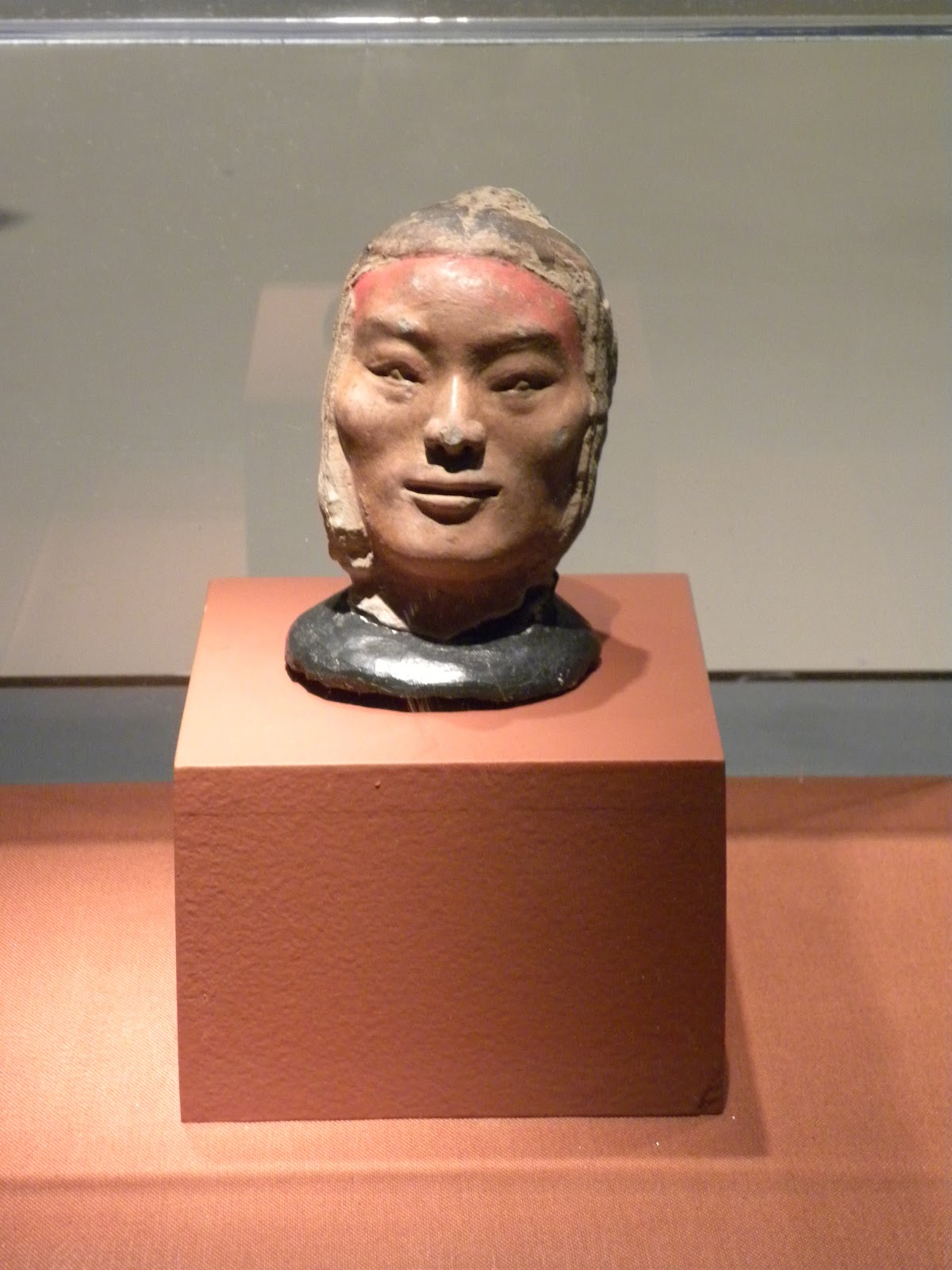
This exhibition features artifacts from three major Chinese dynasties, the Qin, Han and Tang.  The most impressive exhibit greets you when you first enter--the life-size terra cotta soldiers  created to protect China's first emperor Qin in the afterlife.  It surprised me to learn that like the Egyptians, these emperors believed they could take not only possessions but people (even simulated people) into the afterlife.  Acres and acres of buried warriors, horses, and chariots were discovered in a mausoleum complex that is considered the eighth wonder of the world.  Fortunately, this museum allowed us to take pictures:


You can see hints of the brightly colored paint that once covered the figures.


Originally the terra cotta soldiers all held weapons.

A picture of one of the excavation sites.


Each statue's face was patterned after an actual warrior in the Emperor's army, and there are thousands of them.  Rank can be determined by the hairstyles and head adornments.


The Han emperors miniaturized their 40,000 smiling terra cotta soldiers which look
more like cookie cutter dolls in comparison to the Qin warriors.


The Han Dynasty also included animals, concubines and a multitude of objects to insure a comfortable and lavish afterlife.

Saturday, January 28, 2012

BETWEEN HERE AND THERE

I planned on stopping in Auburn, CA to visit my friends Kay and Tom for a couple of weeks before going home.  Shelly wanted to accompanying me but came down with something that left her speechless (literately--she had laryngitis for days) and was very sick.  I would have loved her company but I assured her I would be just fine on the road by myself.  I decided to break up the nine hour trip by staying in Redding overnight and continuing on to Auburn the next day.

On Saturday, January 14, the kids waved to me as my overstuffed Olds and I bounced down the driveway.  It was very cold and lightly raining when I started out.  A heck of storm was headed straight for White Salmon that night and Shelly and Michael were afraid I might get caught in some of it in the pass.  They had me call at every gas station fill up just in case.  But every mile I traveled the weather became nicer and nicer.  And the warmer the temperature became and the bluer the skies the  happier I was to be speeding toward sunny Southern Cal.

It was an incredibly beautiful drive.  I didn't realize that Oregon has such lovely farm land.  I could have spent a week photographing one textbook red barn after another, and vowed I would do just that one day.  Then it occurred to me that I was in no hurry and what a shame it would be to rush through such gorgeous country.  One of my favorite places to visit is Ashland, Oregon and when I saw the sign pointing to the exit, I said to myself what the heck, I'll spend an hour in Lithia Park.

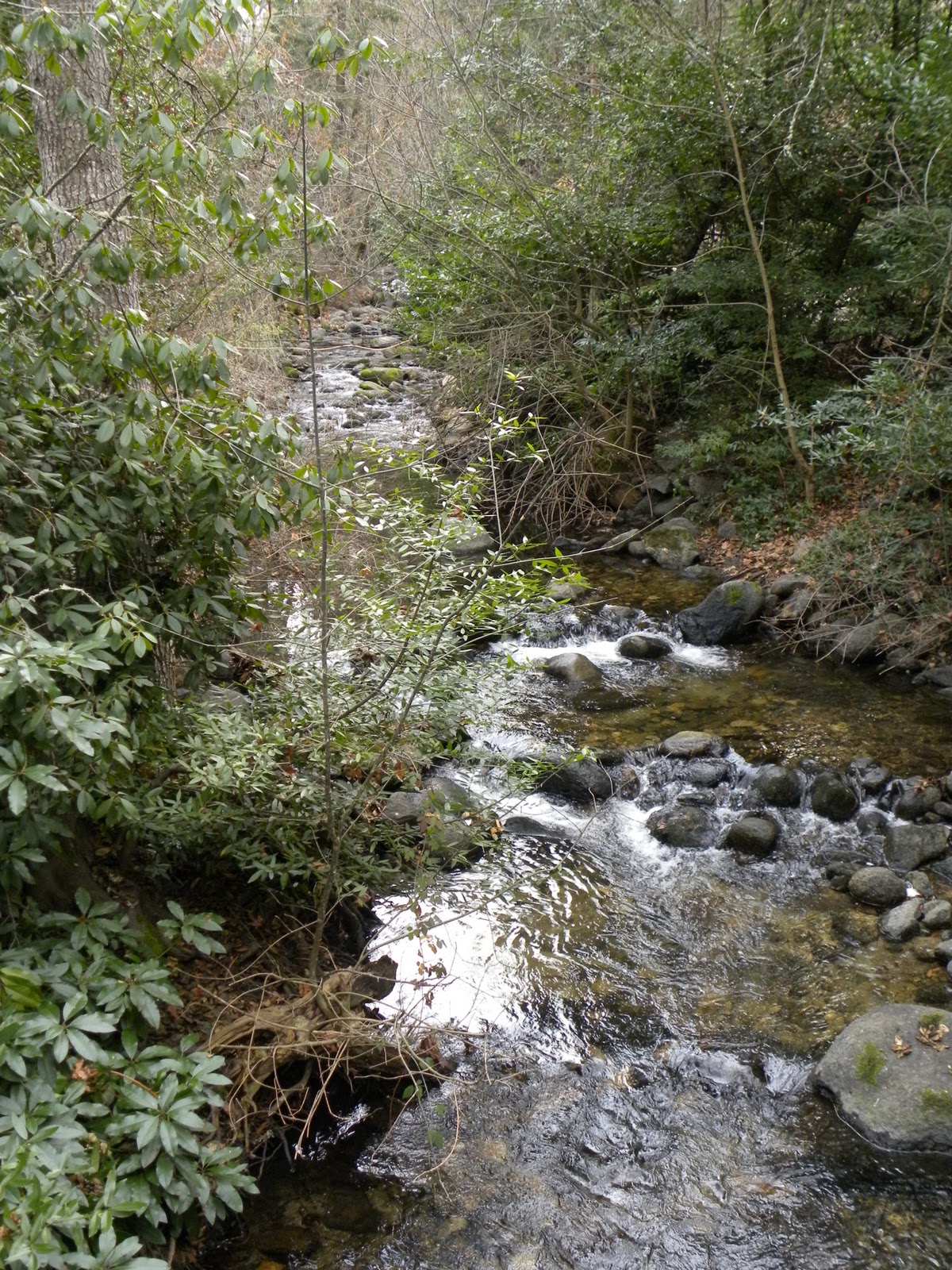
I could live in Ashland.  It is a beautiful cosmopolitan town nestled in the green hills of lower Oregon.  They host the famous Oregon Shakespearean Festival which is presented in an authentic Globe style theater, plus they have a university all tucked among quaint Victorian homes.  And right downtown there is a picturesque stream flowing through one of the prettiest parks I've ever seen.  Lithia Park is of course prettier in spring and summer, but I will have to come back to show you what it looks like then.


Back on I 5, Mt. Shasta soon loomed up out of the flat farm fields.   I snapped picture after picture of it while I was driving.  It was a dumb thing to do, but what a sight!


I did stop to take this one.
I stayed overnight in Redding, CA and the next morning I drove a couple of miles to photograph the Sundial Bridge.  It is a walking bridge over the Sacramento River.  The deck of the bridge is made of opaque green glass and one can glimpse the shimmering river below.  The bridge is designed to also act as a giant sundial, which accurately marks the time.made of opaque green glass and one can glimpse the shimmering river below.  The bridge is designed to also act as a giant sundial, which accurately marks the time.


From now on I will plan a journey allowing plenty of time to discover what is out there to see and do between destinations.  The whole trip can be about what is between here and there.