Bath, A Love Story
Before
I begin, I have to tell you that I don’t just like Bath, I love Bath. Besides being a gorgeous
city, the Bath we see today was built in my favorite era, the Georgian period,
when Mozart, Marie Antoinette, George Washington and Jane Austen were the
conversation of the day. Old George the III may have been a bit batty, but the
times sparkled with brilliance and innovation. Bath is a true reflection of
both.
Thank you, Emperor Claudius
Addicted
to bathing, we have the Romans to thank for creating Bath in 43AD. One look at
the scalding mineral spring that bubbled up into steaming pools and the
industrious Romans promptly began construction on a communal bath house. Gradually
expanding into a town, Bath happily provided the Roman garrisons a place to
kick back and refresh after a long day of conquering for the next 500 years.
When they withdrew from Briton around 577AD, however, the bath and temple
complex gradually fell into disrepair and slowly silted over. (For more about the
Roman baths, go to the post: “Stonehenge and Bath, a Page From My Journal”,
October 22, 2012)
It took another 1,100 years for Bath to
flourish again, thanks to portly Queen Anne and her gout. Her royal visits
beginning in 1692 “to take the waters”, inspired the rich and famous to follow
her lead, making Bath the place to be seen. And with that,
an ancient place of bathing began a new life.
The City of Golden Stone
However,
we owe the beauty of Bath to an enterprising young man from Cornwall, Ralph
Allen. After
moving into town in 1710 for a new job, he noticed that although the town
attracted the well-heeled, it still had a frontier town quality about it. An
ambitious visionary, he could see the town’s potential, and soon turned his
attention to land development. He bought the local limestone quarry, and hired
the best architect he could find, Mr. James Wood from York, and together they set
out to transform Bath. Their vision, which already had the beautiful Avon River
running through it, would be a town filled with parks, broad avenues for
walking, and lovely Greek and Roman inspired public buildings and townhouses
where the wealthy could spend summers away from London--all built out of the
golden hued limestone from Mr. Allen’s quarries.
The Circus and The Crescent
The Circus
After
visiting the Roman baths, our tour guide turned us loose for several glorious
hours to wander around on our own. This being my second visit to Bath, I
intended to make the most of it.
Grabbing a Cornish pasty to eat on the run, I
set off to see the most iconic landmarks in town, The Circus and The Crescent.
 Woods,
Sr. designed both of these complexes but died before construction began,
leaving the building of them to his son. Inspired by the Roman Colosseum, the
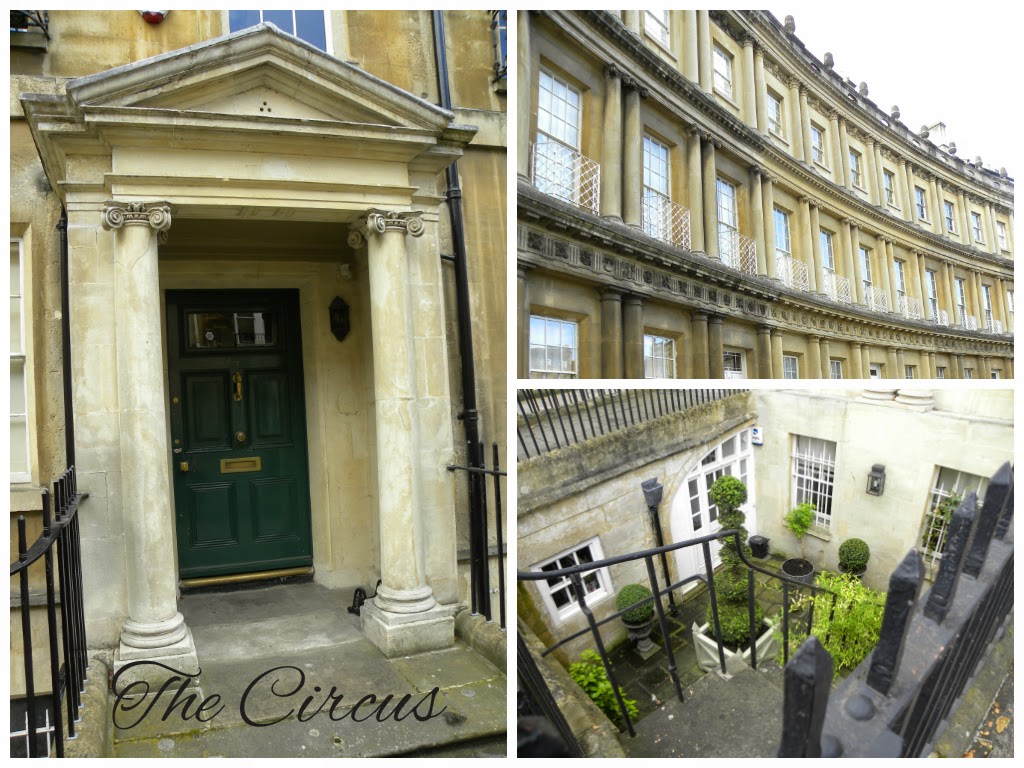
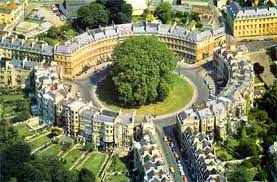
Circus consists of 33 townhouses built in three sections, forming a circle. Originally,
the paved center bustled with dozens of men carrying sedan chairs, hustling to
answer the summons of “Chair Ho!” shouted by the resident servants. Now the
center is a peaceful green space, filled with four enormous trees. (Incidentally,
“Chair Ho” eventually became the greeting “Cheerio!”)
Grateful
to have the time to really appreciate the beauty and symmetry of the townhouses,
I slowly walked around the Circle admiring the soaring Greek columns and the
luminous golden stone used to construct them. I peered into what used to be the
servants entrances, now upscale basement apartments and tried to imagine who
lives there now. I then strolled up the
street about a block to the Royal Crescent (the “Royal” was added after Prince Frederick
stayed there). I wanted to tour one of the only townhouses that are open to the
public, No. One Royal Crescent, now a museum owned by the Bath Preservation
Trust.
The Royal Crescent, No. One is the first end unit on the right.
The
Royal Crescent is a row of 30 magnificent townhouses, and, No. One is the first
end unit. Built in 1776 and owned by Henry Sandford, it is several stories
high, but surprisingly shallow. Each story contains only a couple of front
facing rooms, and behind them are a set of steep and narrow stairs which lead
to each floor. I pitied the servants who had to run up and down those stairs
all day long from basement kitchen to the bedrooms on top. Faintly, I imagined
I heard, “Oh, I say, Poppy. It’s time for my bath. Be a good girl and fetch 43
gallons of hot water to my third floor bedroom right away. Off you go!”
(Images courtesy of Google)
The
townhouse is furnished with what a gentleman of the day would require. There is
the well appointed Dining Room, the Parlor with his bookcases and breakfast
table, the Gentleman’s Retreat with display cabinets spilling over with his
collections; then there is the Withdrawing Room for the ladies which housed the
harpsichord and a table for tea, all on the first two floors. The other floors
contained the bedrooms and servants quarters, and the basement housed the large
kitchen, pantry and servants entrances. There are no bathrooms. Period. Don’t
ask me what the ladies did, but one docent indicated a leather folding screen
in the Dining Room and said, after clearing her throat, “A Gentleman only
needed to excuse himself, go behind the screen and do what nature required in
the chamber pot provided. Shall we move on?”
After
the tour, I decided to walk the length of the Royal Crescent and pretend I was
Jane Austen strolling arm and arm with my sister, Cassandra. I would incline my
head slightly to the other passing gentry, who like my sister and me, enjoyed a promenade
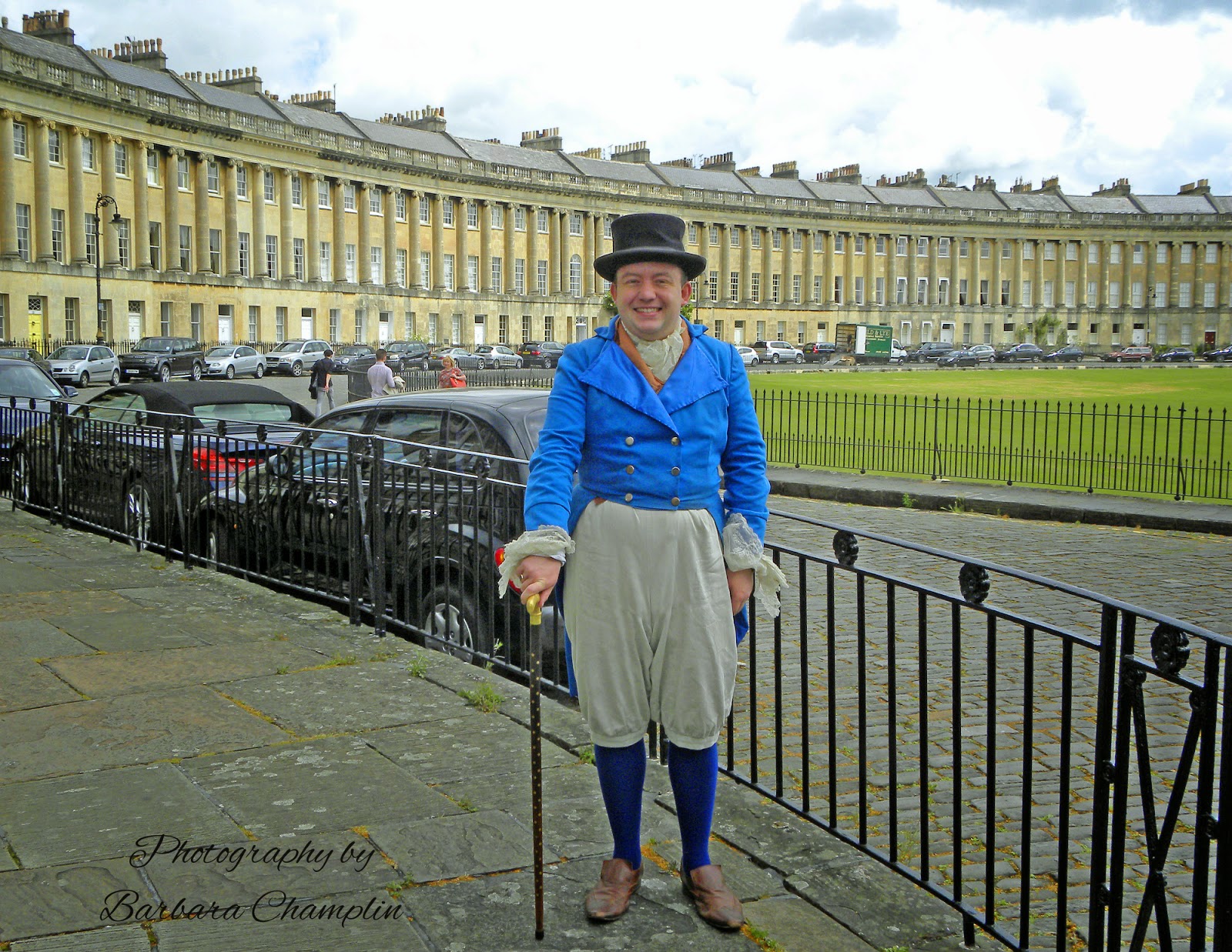
on a lovely summer’s day. As I reached the other end, I noticed a young man
dressed in 18th century costume and asked him if I could take his
picture. He said that I could, but I must realize that he worked as a tour
guide and this was his livelihood. If I wanted his picture it would cost me one
pound (about a dollar and a half, in US money). I dug around in my coin purse
and pulled out a two pound coin and handed it to him, happy enough to help out.
Well, that turned out to be the best two pounds I spent in England. Surprised
that he got twice what he asked for, he said, “You know, I have about a half an
hour before my next tour. If you like, I could show you around the Royal Crescent.
By the way, my name is Thomas Powe and I’m an 18th century
historian.” Thomas Powe
Putting Up A Good Front
“The most interesting thing about the Royal Crescent is that John Wood only designed the façade. It was then up to each original owner to build his own house! The
buyer, purchased how many feet of the façade he wanted, and then employed his
own architect to build a custom house behind, so what may look like two houses
may in fact be only one. Walk with me around to the backside and I’ll show you something few people ever see.”
Thomas
led me around to the rear of the Royal Crescent and showed me what looked like
just a collection of cobbled together tenements. “Because these were built before bathrooms, plumbing and electricity,
everything had to be added to the back. Then, of course, there are the various
and sundry expansions, garages and what not added over the centuries.”
Walking
back to the facade, he continued, “This sort of construction occurs all
over Bath. It's called, Queen Anne fronts and Mary-Anne backs, a metaphor for the fact that most of the houses here have
fancy fronts but common backsides!”
Continuing our walk around the curved face of
the Royal Crescent, Thomas continued, “Many notable people have either lived or
stayed here since it was first built over 230 years ago. One might have easily
seen the likes of Jane Austen, Charles Dickens, Gainsborough, and all manner of
royalty over the years.”
“Who lives here now, Thomas?”
“Many of the flats and houses are privately
owned but a few are owned by a housing association. The middle section is the
Royal Crescent Hotel, and of course, the Georgian house museum is on the end.
You can imagine how expensive they must have been when first built, but now
they are even more so. Priceless, really.”
After a few more minutes of showing me around, I
said good-bye and thank you to Thomas who had to run off for his scheduled
tour. I turned to look at the Royal Crescent one last time then retraced my
steps back through the Circus and down Gay Street.
Jane
Austen’s Bath
I
didn’t realize until I saw the Jane Austen Center on Gay Street that Jane lived
in Bath for five years, from 1801 to 1806. The Center, located a few doors
down from her actual home at #25 (now privately owned), is identical
to hers. I immediately crowded in with the
rest of the star-struck tourists for a tour.
I learned that her years in Bath were mostly happy ones. She, along with her parents and sister, Cassandra first lived in a very nice area in Bath, across from Sydney Gardens. While there, she filled her days and
nights with non-stop socializing, parties and dancing. So much so, she
had little time for her writing. Then her father died and left the Austen women without an income. Having to rely on the charity of her brothers, they ended up
on Gay Street.
 Gay Street was and still is the busiest street
in town, being the main thoroughfare between the center of Bath and the Circle
and Crescent. During Jane’s time, it would have been noisy as well with sedan chairs marching like ants up and down
the steep street all day long. The Austen’s stayed only a year then moved to a country
cottage in Chawton, not unlike the one seen in the movie “Sense and Sensibility”. It made me wonder if her experience in Bath inspired the book...
Although Jane didn’t live in Bath long, the
town, its residents and routine profoundly influenced her writing. No longer
having the distractions of living in a city, she resumed her writing, setting
two of her novels in Bath, “Northanger Abbey” and “Persuasion”.
I
came away happy to know that one of my favorite writers loved Bath as much as I
do.
Jane Austen's home, No. 25 Gay Street


 Several kings and queens are
buried in St. George’s Chapel; the most famous is Henry the VIII. He is buried alongside
his favorite wife, Jane Seymour who died in childbirth. They are buried under the dark plaque in the center of the choir.


