Tuesday, May 6, 2014

10 TIPS ON HOW TO PACK LIGHT AND STILL DRESS LIKE A FASHIONISTA!

BUT FIRST, HOW NOT TO PACK

Back in the good old days before baggage restrictions, I invested in the biggest suitcase Costco had to offer. A huge black monster, it was guaranteed indestructible even if thrown around by a gang of gorillas. The only trouble was the danged thing weighed 15 lbs without a stitch of clothing in it. By the time I stuffed it with half my wardrobe, I couldn't lift it! I literally took my life in my hands just getting it downstairs from my bedroom; the suitcase and I alternately sliding and stumbling until we ended up in a heap at the bottom. And, that was just the beginning of the ordeal--even with rollers, it was hideously heavy to lug around. I speak about that suitcase in the past tense because by now Goodwill has hopefully found it a new home. Now that I’m older and weaker, I realized that time had come to change my ways as far as packing goes.

Another good reason to toss that beefy suitcase (as if not being able to lift it isn't enough) is the baggage charges. If a suitcase weighs over 50 lbs, the charges get obscene! I learned that first hand: The scene is a British Airways ticket counter in London’s Heathrow Airport a couple of years ago. I managed to heave my enormous Gorilla Bag onto the scales and was told it was 3 kilos overweight. The ticket agent looked at me with pity and asked if I could take anything out. “No, that’s OK. I’ll just pay whatever it is.”  For goodness sake, what would I do with 6 lbs of extra stuff after I took it out?  I looked nervously over my shoulder at the humorless mob waiting their turn behind me and asked, “It couldn't cost that much, could it?” To my immense relief, he just shook his head and let me through without charging me. After I got home, I researched the charges on-line and realized just how nice he had been. Those 6 lbs should have cost me $100! (Any bag weighing between 51-70 lbs costs an additional $100, 71-100 lbs is an additional $200!)

I’m going back to England this year and I am determined to take ONE carry-on bag (plus a good size tote). This will take supreme packing skills, but I think I've learned a thing or two over the years.

10 TIPS THAT WILL MAKE TRAVELING A DREAM!

(Men: you can heed this advice as well!)

1.   PICK A COLOR, ANY COLOR: Decide on a basic color scheme and stick to it. It can be black, brown, gray or navy, whatever you like. All of your basic clothes like slacks, jackets and shoes should be one of these neutral colors. Blouses, shirts or scarves are your opportunity for accent colors, like yellow, turquoise or coral. Color coordinating your wardrobe this way insures that everything goes together and you are guaranteed to turn a few heads! (I’ve chosen navy as my base color, with yellow, lime green, orange and pink as accent colors, and of course, good old white.)

 My mix and match travel wardrobe.

2.     SIMPLE AND TAILORED: Make sure that each item of clothing can be worn with every other item, and that at least a few of your basic items can be dressed up, depending on the occasion. For example: Ladies, a silky blouse or shell can dress up a blazer, slacks or skirt. And don’t forget scarves; they can change or dress up an outfit instantly.  Men, a nice shirt and tie worn with a dark jacket and pants will pass for a suit.

3.   THE LIGHTER THE BETTER: Choose clothing that is light weight and washable. I’m always on the hunt for poly-blend clothes that I can hand wash and will dry quickly. Pure cotton is OK, if you like ironing or wrinkles, plus it’s heaver. (Nearly all my clothes, including my wardrobe staple—a navy blue blazer, can be wadded up, thrown into a suitcase and emerge fairly wrinkle free.)  Good tip: Wear your heavier pieces on the plane, like your blazer or coat and walking shoes.

4.   BUY THE BEST YOU CAN AFFORD: Since the object is to take as few clothes as possible you might as well invest in some nice quality pieces. A  well dressed friend of mine has a wardrobe of a miracle fabric called Tencel. It looks expensive, feels like silk, yet wears like army fatigues. Plus, made out of wood pulp, its bio-degradable! My favorite travel wear are from a famous line of travelers clothes, but any label is good as long as the clothes are wrinkle free and fast drying. 

(Pictured is my new carry-on by International Traveller. It weighs just 3.5 pounds! I'm proud to say that I managed quite well in England for three weeks with it and a tote. I felt sorry for people who struggled with their heavy, over-sized bags while I practically sailed through the airports and streets of London!)    
     
5.  JEWELRY: My advice is to take some cute costume jewelry but leave your expensive stuff at home. However, if you do want to bring a few nice items, there are things you can do: (1) store them in the hotel safe when not wearing them, (2) never take them off (3) or, carry them in a pouch hidden somewhere on your body. Whatever you do, don’t leave them in your hotel room.
   
6.    KEEP SHOES TO A MINIMUM: Shoes are my downfall. I want a pair for every outfit, but shoes are heavy so I have to leave my vanity at home. Most trips I take require miles of walking that can’t be done with fashionable shoes. I’ve finally given up trying. At my age, I need sturdy lace-up walking shoes that offer comfort as well as support. (I just have to ignore the fact that they look like I’m wearing combat boots.) Wear your good pair of walking shoes on the plane and pack one or two more for casual or dress.

7.   TWO OR THREE PAIRS OF SLACKS OR PANTS ARE PLENTY: You are going to need a lot more tops (shirts and blouses) than pants. Just be sure they pass the wash and wear test. TIP: Unless you can’t live without your jeans, I’d leave them at home. Don’t get me wrong, I love jeans, but for travel they are heavy, too casual, and in my opinion, worthless in the cold. Besides, I think it’s better to dress up than dress down on a trip. You'll get better service for your efforts!

8.    THINK LAYERS: I travel mostly in the spring and fall, so layering is essential. I bring my light-weight pants, but I also bring at least one pair of thermal underwear and leggings for warmth. A thermal top adds warmth without weight or bulk—couple that with a light rain resistant wind breaker (the most fashionable you can find, of course) and you’re ready for any cold, rainy day.

9.  LEAVE MOST TOILETRIES AT HOME: Take only what you absolutely need. For years, I’ve brought my own special shampoo, conditioner, toothpaste etc., etc. but no more! I haven’t been to a hotel that hasn’t provided these items along with a hair dryer, iron and ironing board. In fact, most hotels now have a little “convenience store” in the lobby stocked with everything from snacks to shaving cream.  I’d rather buy whatever I need and leave it there. That way I can avoid the weight, and the inconvenience of stuffing little leaky containers into a quart bag for airport security.

10.  CARRY ANYTHING YOU CAN NOT AFFORD TO LOSE ON THE PLANE WITH YOU: That includes your camera, extra batteries, prescriptions and all of your ID’s—passports, keys, credit cards, cash etc., as well as phone and camera chargers. After I check in, I put my passport and all valuables in a hidden pouch somewhere on my person.  If you check your baggage, carry a change of underwear. When I flew to Italy, the airline lost my luggage and I was very glad I had a few days of clean undies! (**For overseas travel, you must have a Voltage Converter for your electronics. Carry that with you also.)

FINALLY: When thinking about whether or not to bring an item, just ask yourself, “Do I really want to lug this around?” A quick check of your back and bunions will give you your answer!

CARRY IT OR SHIP IT?

These days, if you don’t mind how much it costs, you can let UPS or FED EX ship your luggage (check companies for details) and it will be waiting for you at your hotel or home. How nice would THAT be? Again, this takes some preplanning, but worth it for hassle free travel. And, for what airlines are charging in baggage fees these days, it just might make more sense to do it that way.

Other luggage shipping companies:
Sports Express: www.sportsexpress.com
Luggage Express: www.usxpluggageexpress.com
Skycap International: www.skycapinternational.com


 I just heard on the news that Frontier Airlines will now charge for carry-on luggage: $25 if you pay on-line with your reservation, $50 if you wait until you show up at the gate! They did say they lowered their ticket prices by 12%, but still. Shipping those bags may be the way to go in the future.

HAPPY TRAVELING!

(**Photo of large suitcase courtesy of Google Images)

Sunday, April 13, 2014

MT. VERNON, VIRGINIA: WHERE GEORGE WASHINGTON CALLED HOME


 Mt. Vernon is close to Alexandria, Virgina, 15 miles outside of Washington, D. C.
Map courtesy of World Atlas

On to Maryland, Washington, D. C. and Virginia

It’s just a short plane ride from Boston, where I said a reluctant good-bye to my good friends, Pat and Bill, to Baltimore, Maryland. I planned to spend a few days there with another couple I met on that fantastic trip to Great Britain, Chuck and Paula. We became instant friends while on the tour and I really looked forward to spending more time with them. A couple determined to enjoy every minute of every day, I knew it would be a week to remember!

When Paula asked me what I wanted to see during my visit with them, I crossed my fingers and gave her my wish list. I said, “I’d like to see Mt. Vernon, Washington, D. C., Monticello and anything else you’d like to show me!” I’m glad I asked because Chuck and Paula gave me the royal tour, going above and beyond anything I could have imagined. Not only did we see everything on my list, they also took me to D. C. twice, the seaport town of Annapolis, and Montpelier, James and Dolley Madison’s home in Virginia. Plus, they hosted two dinner parties for friends and neighbors to meet me and generally wined and dined me like a Dowager Duchess. In fact, they just about wore me out! Allowed only two cups of coffee before I was hustled into the car for a day filled with nonstop sightseeing, we didn’t come home until late every night. And, I loved it!

First stop: Mt. Vernon and George’s Teeth

Situated high on a grassy knoll overlooking the Potomac River, Mt. Vernon is only about 15 miles outside of Washington, D. C. Getting there took us through lush rolling hills scattered with fine looking horses; a perfect example of a bygone era of refined plantation living.

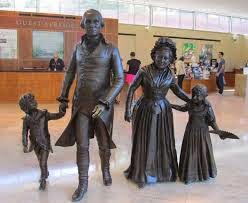
Shortly after arriving at Mt. Vernon, the visitor is first ushered into a world-class museum. Like honored guests, they’re met by George and Martha, or at least life-size bronze statues of them, and two of their grandchildren, who seem to be rushing by on their way to somewhere on the plantation. Martha, barely 5 feet tall, doesn’t even come up to George’s shoulder and you can just imagine that it takes her two steps to his one just to keep up! The fluid, life-like movement of the bronzes set the stage for this museum that turned out to be one like no other I’ve ever seen.
 

Consisting of seven galleries and two theaters, the museum has over 500 items from the Washington’s lives. The curators made Washington the man almost real. They placed life-sized avatars of him in the clothes he wore, surrounded by his personal possessions--so life-like I waited for him to move. Vignettes of him sitting regally on horseback in full military uniform, and being sworn in as President of the United States, show him  handsome and tall, with a natural leader’s grace and bearing, effortlessly commanding respect.

And yet, around a corner I found a set of his false teeth and the myth became the man. Washington suffered from periodontal disease, and despite his best efforts eventually lost all of his teeth. His dentures, a horrid contraption made of hinged metal plates embedded with teeth made from hippopotamus ivory, are a vivid reminder that he lived everyday in discomfort and pain having to wear these torturous things. I could not imagine trying to talk with that contraption in my mouth let alone eat with them. (Washington had many sets of teeth made, but the only complete set is in the Mt. Vernon museum.)
 
Before leaving the museum to see the house, we stepped into one of the theaters to see a movie called “We Fight to Be Free”. Twenty-five minutes long, it starts with Washington as a young man in the French and Indian Wars, then follows his courtship and marriage to Martha Dandridge Custis, a wealthy widow with two children, and ends with the bitter battles of the Revolutionary War. The massive screen wraps around the audience, enveloping and drawing us in. I swear my seat moved with the waves during Washington’s crossing of the Delaware River and I felt real snowflakes falling from the sky! I heard as well as felt the rumble of the far off cannons as I strained to see through the fog. At the end, I was moved to tears when a tired leader finally made it back home to his family after eight long years of war. It is undoubtedly one of the best interactive museum experiences I have ever had! Really well done!

 The front of the house, outbuildings and gardens.

 It Pays to Be Last

After going through most of the galleries, we made the trek up the hill to Mt. Vernon, the home. Being mid-afternoon, the crowds had thankfully thinned, but even then a sizable group of us lined up to go through the house. Bunched together in a tightly packed clump, we shuffled awkwardly through the tight corridors dodging heads and elbows as we labored to see into the rooms. “No photographs allowed!” the docents warned. “No touching either!”  Eventually, I found myself outside and thoroughly disgruntled that I hadn’t seen or learned much of anything. 

 Slave's quarters, workshops and blacksmith's shop

We spent the rest of the afternoon wandering around enjoying the view of the Potomac River from Washington’s piazza (his back porch), and going through the outbuildings where the kitchens, work spaces and slaves quarters are. We met some real blacksmiths demonstrating how tools were made on the farm, and docents acting like George and Martha. One of the guides whispered that “George” would only answer if you called him “The General”. So, I asked “The General” if I could take his picture.

 “Mr. General, Sir! May I capture your likeness with this small box?” which he granted me permission to do with unsmiling dignity and I actually had to stop myself from bowing!


Then suddenly, I looked around and realized everyone had left except for the docents and the three of us. With time remaining on the clock, one of the docents I’d been chatting with asked if we wanted a private tour of the house! I jumped at the chance, while Paula and Chuck elected to sit outside in the cool breeze.

I could not believe my luck! This time when I entered the home, I felt like a guest. The docents stood silently by and allowed me free rein to wander the halls. I couldn’t go into the rooms, but I could clearly see into them and in doing so, my imagination took flight. At the foot of the staircase I imagined George Washington pausing to look at his prized possession, the framed key to the Bastille that his close friend and frequent visitor, the Marquis de Lafayette gave to him. I could see laughing children running up the ornate staircase in the spacious entryway, hanging onto the banister as they went.

The small dining room, waiting for the family to sit down and eat, boasted walls of bright emerald green. Washington was proud of that color and had personally selected it. The intense, saturated color was expensive and fitting for a house like his.

Leaving the entryway, I walked through a small yellow guest bedroom and climbed a modest set of narrow stairs to the second floor to George and Martha’s bedroom. A spacious room with a fireplace, upholstered chairs, and pictures of the grandchildren, it is comfortable and unpretentious. But, it is the canopied bed that I couldn’t stop looking at. It is where George Washington died. In 1799, just two years after retiring to his home, he became gravely ill after riding his horse in cold and snowy weather. Doctors came right away, but were powerless to do anything but comfort him until he died. His last words were, “I die hard, but I’m not afraid.”

The bed and bedroom were never used again. Martha moved her bedroom 
to the third floor. She died three years later.

Alone in his home and just inches from where he died, I felt a profound connection with George; no longer the tall, strong general, but a fragile and finite human being, someone like all of us who has experienced love, desire, anger and pain. I consider it a privilege to have been allowed this private moment.

The docents walked down the hill with us and waved good-bye. Sometimes it pays to be last.

Next time: Washington, D. C.

Good read: “1776” by David McCullough. Although interesting it’s not compelling, and frankly, it took me several tries to get through it, but I’m glad I finally finished it. I learned a great deal about George Washington and this decisive year in the Revolutionary War.

Sunday, March 9, 2014

CONCORD, MASSACHUSETTS: THE PLACE THAT SHAPED A NATION


Top: Minute Man Statue and the Old North Bridge
 Middle: Walden Pond   Bottom: Wayside Inn

Exploring Colonial America: First Stop--Concord

After spending a wonderful few days on the islands of New England, I drove back to Boston where I stayed with Pat and Bill, friends I made on the “England, Scotland and Wales” tour in 2012. I couldn’t have asked for more gracious hosts. They not only invited me into their beautiful home, but took great care to show me many historic places that are practically in their backyard! I walked around Thoreau’s Walden Pond, visited Louisa May Alcott’s home, ate lunch at the oldest working inn in America (Longfellow's Wayside Inn), and stood on the very spot where the Revolutionary War began.

 Left,Thoreau's Walden Pond--Right, my friend and guide, Pat.

 Dorothy finally leaves Kansas

Being a girl raised in the west, early American history has always been merely words in a book. It’s only when I see these places of great significance to our heritage do they become real to me. In seeing them, only then do they become profoundly meaningful in a way that is hard to describe. I sometimes feel like Dorothy in “The Wizard of Oz” waking up into a whole new reality. Take for instance the first place Pat took me to visit:  Louisa May Alcott’s home in Concord.


Orchard House, Louisa May Alcott’s Childhood Home


Most everyone knows that the Revolutionary War started on the fields of Concord, which forever changed our nation’s course. However, I didn’t realize it also was the hotbed of intellectual thought, which in turn changed our nation’s philosophy. Surprisingly, one of the most unlikely spots for that to happen was in Louisa May Alcott’s childhood home, located right in the heart of Concord. Louisa, as you may recall, wrote Little Women, a favorite childhood story about growing up in her “orchard house” along with her three sisters, mother and often absent father. And, it is the father, Amos Bronson Alcott who surprised me.


Transcendentalism made easy

Louisa’s father, Amos Alcott, a respected social and educational reformer was a staunch proponent of Transcendentalism as were his friends and neighbors: Emerson, a philosopher, Thoreau, a naturalist and rebel, and Hawthorne, a novelist. From 1834 to 1888, these four leading intellectuals called Concord home. If you are anything like me, I’ll bet you thought Transcendentalism came over with the Beatles and the Maharishi in the 60’s. What the heck IS Transcendentalism, I thought as I roamed from room to room in the Alcott’s home.

It seems it all started with Emerson’s Essay on Nature in 1836, which simply stated that “…people, men and women equally, have knowledge about themselves and the world around them that “transcends” or goes beyond what they can see, hear, taste, touch or feel. This knowledge comes through intuition and imagination not through logic or the senses. People can trust themselves to be their own authority on what is right.” I’ll bet that went over big with the local churches!  ushistory.org

 Louisa May Alcott's home. She wrote Little Women at the age of 26 in her bedroom on the second floor.


Although money was always short in the Alcott home, it had to have been a wonderful place to grow up. Mr. Alcott believed in the equality of women and the freedom of the human spirit to achieve in an encouraging atmosphere. As examples of his educational philosophy, he famously encouraged a student to take a ruler to his own hand when he made a mistake, and allowed the baby in the family, May, to draw all over the walls of the house because they couldn’t afford to buy paper. What a great dad!

Amos Bronson Alcott's school house next to his home.

Longfellow’s Wayside Inn


Leaving the Alcott’s home, Pat and I drove to nearby Sudbury and enjoyed lunch at Longfellow’s Wayside Inn, the oldest continuously working inn in America. Built by David Howe in 1716 as a “hous of entertainment”, it sits beside the old Boston Post Road, one of the first mail routes in the country. Henry Wadsworth Longfellow visited Howe’s Tavern in 1862 and was so taken by the place he wrote a series of poems called “Tales of a Wayside Inn”, one of which “The Landlord’s Tale” (more widely known as “The Midnight Ride of Paul Revere”) made the place famous. The Inn was renamed in Longfellow’s honor in 1892. Longfellow's Wayside Inn.

Longfellow's Wayside Inn, the oldest working Inn in America.


Henry Ford bought the Wayside Inn in 1923 with the intention of creating a living museum of Americana. He added buildings to the property including the one-room Redstone School (relocated onto the property in 1925), a fully functioning Grist Mill (built in 1929), and the Martha-Mary Chapel. Read more.

 Redstone School House, 1798. Scene for the famous poem "Mary Had a Little Lamb". (For those of you who remember Sean, he volunteered to pose as the "lamb".)

 Grist mill, 1929. Built by Henry Ford as part of a park dedicated to Americana.

Martha-Mary Chapel next to the Little Red Schoolhouse.

Old North Bridge and the "shot heard 'round the world"

After a deliciously authentic lunch of chicken pot pie, Pat and I drove a short distance to see the Old North Bridge on Battle Road. It was here that one of the successive owners of Howe’s Tavern, Ezekiel Howe an officer in the colonial army, led the Sudbury Minute Men into battle with the British that started the Revolutionary War. Starting at dawn on April 19, 1775, they fought the Red Coats all day long eventually forcing them the entire way into Boston. There they claimed victory in Charlestown at the Battle of Bunker Hill.


The battle that forever altered our destiny took place at the Old North Bridge and where the famous “shot heard ‘round the world” was fired (a line from Emerson’s poem, Concord Hymn). The British, defending the bridge, shot first at the approaching militiamen but retreated when the colonists returned fire.


 Old North Bridge, site of the "shot heard 'round the world" and the start of the Revolutionary War in 1775. 
The Minutemen Statue commemorates the date.


As I looked around at the peaceful fields and hand stacked rock fences, I could just make out the distant sounds of gunfire and shouts of the soldiers on the quiet breeze rustling through the trees. To think that such a momentous occurrence took place in a lovely bucolic landscape is hard to imagine, but at the same time, I felt the spirits of those brave men who had the courage to stand up for what they believed in and my heart gave thanks for a country where I can live in freedom.


Thanks a million, Bill and Pat!


***Double click on any picture for a full screen slide show.


Good reading:  “The Concord Quartet: Alcott, Emerson, Hawthorne, Thoreau and the Friendship That Freed the American Mind” by Samuel A. Schreiner Jr.

Next time: Mount Vernon and the Hunt for George’s Teeth!